

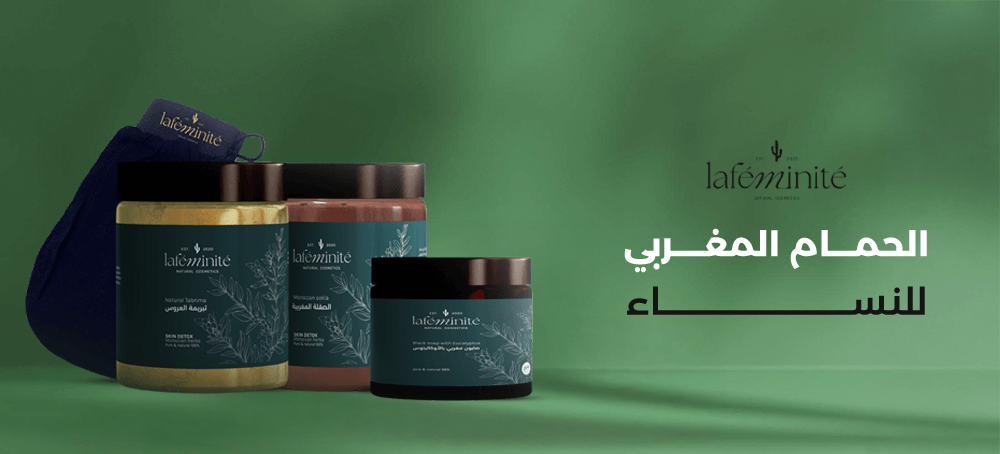
Moroccan bath for women at home | Complete routine using Lavimenite products
The Moroccan bath for women at home is of utmost importance, especially in the fast-paced world and the accumulation of daily pressures in which we live. Our bodies may remain susceptible to the accumulation of dead cells and dirt that is not visible to the naked eye, which is reflected in the smoothness of the skin, its radiance, and even its color. Therefore, the Moroccan bath stands out as a natural ritual that restores to the body radiance, freshness, and silky smoothness, without the need to go to a salon.
With original Laviminette products With Moroccan soap , loofah , scrubs , and natural oils, you can easily perform a safe and complete Moroccan bath at home, leaving you with smooth, even-toned, radiant skin, as if you just stepped out of a luxurious spa.
In this guide from Laviment store you will find a comprehensive routine: steps to prepare a Moroccan bath at home, using Laviment products, tips to maintain softness and freshness, amazing benefits for your skin and body.
What is the Moroccan bath and why do women in Saudi Arabia love it?
The Moroccan bath is a traditional ritual dating back centuries in North Africa, combining steam, Moroccan soap, exfoliation, and moisturizing to deeply cleanse and purify the skin, remove dead skin, and rejuvenate it. Many women in Saudi Arabia prefer it for several reasons, the most important of which are:
- It suits the local climate and provides warmth and cleanliness.
- It helps to lighten the body and even out skin tone.
- It eliminates dead skin and gives smoothness and shine.
- It serves as a home spa, saving time and money compared to visiting salons.
Benefits of the Moroccan bath for the body and skin
The Moroccan bath is considered one of the best body care rituals, offering tangible results for smoother, healthier skin. Steam, Moroccan soap, and a Moroccan loofah are used to create a comprehensive care experience that includes:
Highly effective removal of dead skin cells
- The deep exfoliation process removes buildup and dead skin that causes dullness, revealing a smooth, clean surface that is more ready to absorb moisturizing creams.
Lightening and unifying body tone
- The Moroccan bath helps to fade dark spots and pigmentation caused by friction or sun, while improving skin texture and giving it a uniform color with regular use.
Stimulates blood circulation
- Heat and steam, along with a light massage with soap and a loofah, stimulate blood flow, which gives the skin a bright and vibrant appearance.
Deeply moisturizes and nourishes the skin
- After exfoliation, the skin is at its most receptive to absorbing natural oils and moisturizers, which enhances its elasticity and prevents dryness.
Calming the body and relieving stress
- A Moroccan bath session provides a strong sense of relaxation, as the warm steam relieves muscle tension, while the exfoliation gives a feeling of lightness and psychological comfort.
Preparing the body before the Moroccan bath
To ensure the best results from a Moroccan bath at home, you must prepare your body by following these consistent steps:
First: The most important step is steaming and opening the pores. Start with a hot bath or steam shower for 5 to 10 minutes. This helps open the pores and soften the skin, making it easier to remove impurities and dead skin cells during exfoliation.
Second: What tools do you need before starting?
- Authentic Moroccan soap (for deep cleaning)
- Authentic Moroccan loofah for body exfoliation
- Moroccan scrub/scrub or a brightening product such as Aker Fassi or Nila (for brightening and cleansing)
- Natural body oil or moisturizer (post-shower moisturizer)
All of them are available on the Laviment website at the best price and quality in Saudi Arabia and the Gulf countries.
Equipping these tools guarantees you a complete and safe Moroccan bath.
Moroccan bath steps at home for women
1- How to use Moroccan soap at home: Start with the steam stage to prepare the skin, then distribute the original Moroccan soap from La Vieminette all over the body.
Massage gently and leave it for 5 to 10 minutes to soften the skin and open the pores. This step is essential because it dissolves impurities and helps to gradually lighten the skin, so that it is ready for effective exfoliation.
2- How to use a Moroccan loofah: After rinsing off the soap, wet the loofah with warm water and begin scrubbing in circular motions from the bottom up. Within minutes, you will notice the dead skin flakes coming off—a clear sign of successful exfoliation, as this step gives you a smooth texture, helps even out your skin tone, and softens rough areas.
3- Exfoliation with a scrub or Moroccan scrub: After finishing with the loofah, use a natural scrub or scrub to deepen the lightening and remove accumulated cells, especially on the knees, elbows, and lower legs. This step adds extra radiance and noticeably increases skin smoothness.
Whitening masks after a Moroccan bath
Using Moroccan indigo or herbal masks, Laviminette's skin-lightening products rely on natural ingredients such as Moroccan indigo and effective herbal masks. These are applied to the skin for 10–15 minutes after exfoliation to lighten the complexion, soothe the skin, and give it a radiant glow. This step is ideal for those seeking quick and visible results in skin lightening.
Regarding the timing of using brightening masks, it is preferable to apply the mask immediately after the peeling session to achieve maximum effectiveness. If your skin is sensitive, it is preferable to separate the peeling and mask sessions by 48–72 hours to avoid redness.
Moisturizing the body after a Moroccan bath
Laveminette Body Butter or Moisturizing Oil
After completing all the steps, gently dry your skin and then use a body butter or natural oil from Laveminette.
This stage is essential for maintaining skin hydration, soothing it, and preventing dryness after the peeling process.
Tips for maintaining smoothness for longer
- Drink enough water after your bath session to compensate for fluid loss.
- Maintain a daily moisturizing routine suitable for your skin type.
- Avoid sun exposure for 24 hours after the lightening session.
- Make the Moroccan bath a part of your routine according to a fixed and suitable schedule.
How often do you do a Moroccan bath?
Bath session schedule according to skin type
- Normal or combination skin: One session every two weeks to maintain clarity and brightening.
- Sensitive skin: One session every 3–4 weeks to avoid any irritation.
- Preparing for an event (wedding, photography, celebration): A session 5 or 7 days before the event, with an additional light session 3 days before.
Adhering to this schedule will give you better results and reduce the likelihood of irritation.
Essential tools for a successful Moroccan bath session
To get the best results from a Moroccan bath at home, you'll need a few essential products that work together to prepare, deeply cleanse, brighten, and moisturize your skin. Here's a clear and concise explanation of each product and its role in the routine:
Original Moroccan soap
This is the first and most important step in the Moroccan bath. It helps to open pores, dissolve fat, deeply cleanse the skin, and sterilize it, preparing it for the exfoliation stage.
Moroccan loofah
An essential exfoliating tool that removes dead skin cells, smooths the skin, and stimulates blood circulation. Using a loofah after soap makes exfoliation more effective and results more noticeable.
Moroccan body scrub (such as indigo or herbs)
This step comes after cleansing and exfoliating the skin, and helps to lighten the body, even out skin tone, reduce pigmentation, and give the skin a silky smoothness.
natural body oil or moisturizer
It is applied as the final step to close pores after the session, and helps to deeply moisturize and nourish the skin, giving it a healthy appearance and a long-lasting smooth texture.
Frequently Asked Questions:
How often can I do a Moroccan bath at home?
For optimal results, once every two weeks for normal skin, and once every 3–4 weeks for sensitive skin.
Does the Moroccan bath actually lighten the skin tone?
Yes, thanks to the removal of dead skin, exfoliation and skin renewal, and with a brightening product such as indigo or a natural scrub, the results appear gradually.
Is it possible to use the Moroccan bath for all parts of the body?
Yes, with caution in sensitive areas and with minimal rubbing when using it for the first time.
Do the results last long?
If moisturizing is done after the session and a suitable schedule is followed, the results last longer—smoothness, radiance, and rejuvenated skin.
Make your home spa start today, and don't wait to go to the spa… Try the Moroccan bath from Lafeminette now at home, and give your skin softness, radiance, and safe, natural brightening.
Browse the Moroccan bath collection , add your products to the cart, and enjoy fast shipping within Saudi Arabia.
Bathe — Exfoliate — Moisturize… and show off your most beautiful skin.
Topics that might interest you:
Laviment's very distinctive collections
- Original prickly pear oil from Laviment: The secret to firm, radiant, and wrinkle-resistant Saudi skin
- Pure prickly pear oil: Liquid gold for firmer skin and natural radiance
- Your guide to understanding the most important benefits of jojoba oil for the skin
- The difference between argan oil and prickly pear oil | Which is better for your skin?