

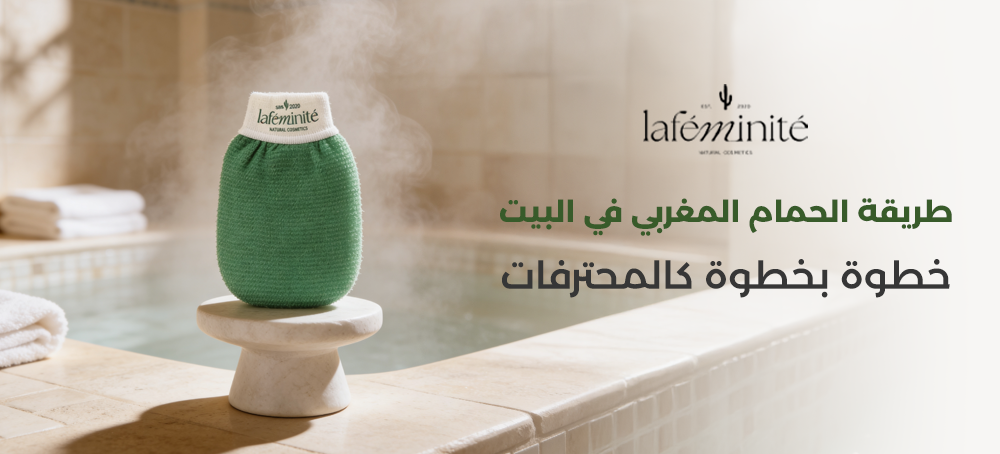
The Moroccan bath method is no longer exclusive to expensive salons, nor is it limited to a Moroccan loofah, Moroccan soap, or exfoliation. Today you can apply the original Moroccan bath in your home and achieve professional results that rival those of specialized centers, at a lower cost and with complete privacy.
In this guide from Laviment you will learn the correct method, product arrangement and the correct scrubbing technique, to get fantastic softness and deep clean from the first time.
Get a Moroccan bath package Best price now
What is a Moroccan bath?
The Moroccan bath is a traditional grooming ritual that relies on steam as a first and essential step, traditional Moroccan soap , and a special loofah to remove dead skin and deeply cleanse the skin. It aims to renew skin cells, soften the texture, and stimulate blood circulation, giving the skin a brighter and healthier appearance.
The Moroccan bath is considered one of the oldest methods of natural care that focuses not only on cleanliness, but also on renewing the skin and restoring its vitality in a complete way, and it relies on a Moroccan loofah and Moroccan soap.
Why choose a home Moroccan bath?
Choosing to have a Moroccan bath at home gives you significant advantages compared to salons:
- To save on the high cost of salons, you can repeat it several times for approximately the same cost as one session at some centers.
- Privacy and comfort in your own home, no appointments, no waiting, no embarrassment — enjoy your experience in complete peace.
- Complete control over the products used. You choose the products that suit your skin and avoid any ingredients you do not prefer.
- It can be repeated regularly without prior appointment; whenever you need a renewal session, you can apply it immediately.
The result: Softer, clearer, and naturally more radiant skin — with a truly relaxing, spa-like sensation.
Preparing the Moroccan steam bath
For a truly relaxing experience, you need to transform your bathroom into a real spa experience at home:
- Use soft lighting
- Play relaxing music
- Add a few drops of essential oil
- Dedicate a full hour to yourself
Skincare is not a luxury... it's an investment in yourself.
Essential tools for a Moroccan bath
To get an accurate result, you will need the following tools:
The original Moroccan loofah: essential for effectively removing dead skin.
Traditional Moroccan soap: helps to soften the skin and prepare it for scrubbing.
Moroccan clay (ghassoul): Deeply cleanses the skin and absorbs impurities.
These three tools are the foundation of a successful Moroccan bath.
Arrange the products in the correct way
This is an important step because incorrect ordering significantly reduces the result. Here's the recommended method:
1- Preparing the body with steam
- Take a warm shower for 5–10 minutes.
- The goal is to open the pores and soften the skin.
2- Applying Moroccan soap
- Spread a thin layer all over the body.
- Leave it on for 5–10 minutes without rubbing.
Very important: Do not use shower gel before scrubbing with a loofah, because it closes the pores and reduces the removal of dead skin.
3- Scrubbing with a Moroccan loofah
After rinsing the soap off with warm water, start scrubbing.
4️- Applying Moroccan clay
- Apply after you have finished rubbing.
- Leave for 10 minutes then rinse.
5- Final hydration
The final touch is always moisturizing. Use a moisturizing oil or cream to close the pores and maintain smoothness for as long as possible. Moisturizer soothes the skin, nourishes the complexion, and is gentle on open pores.
Laviment is a skincare store that pampers your skin and restores its radiance. Laviment is not just about products.
The correct way to rub
The method of using the Moroccan loofah for exfoliation is the real secret to the result. Many women make mistakes here, which makes the Moroccan bath "not give results".
The correct way:
- Make sure the skin is moist and warm.
- Squeeze the loofah well to remove the water.
- Rub with steady, longitudinal movements
- Don't press too hard.
- Focus on rough areas (knees, elbows, heels)
You will notice dead skin coming out in gray rolls — this is proof that the process is successful.
Benefits of the Moroccan bath for the skin
The Moroccan bath is more than just a simple body cleanse; it's a complete rejuvenation session that restores your skin's vitality and radiance from the very first time. Thanks to the steam, Moroccan soap, and special loofah, the dead skin layer that makes the skin dull and rough is removed, revealing a smoother, clearer complexion.
Among its most notable benefits is that it helps to noticeably soften the texture, even out skin tone, and improve the absorption of creams and oils after the treatment. It also boosts blood circulation, giving the skin a natural and healthy glow.
With regular use, you'll notice a reduction in the appearance of roughness, an improvement in the texture of dark areas, and a feeling of deep cleanliness that lasts for days. It's a simple routine with visible results that brings the spa experience into your home.
Common mistakes that prevent the result from appearing
Five mistakes to avoid when performing a Moroccan bath at home are:
- Use shower gel before scrubbing
- Rubbing on cold skin
- Apply a moisturizer before completing the steps.
- Bathing more than twice a week
- Use a regular loofah instead of a Moroccan one.
No, because small details make a big difference.
How many times should a Moroccan bath be repeated?
The frequency of Moroccan baths depends mainly on your skin type and skin thickness, as the goal is to remove dead skin without weakening the skin's natural barrier.
Moroccan bath for normal skin
It is recommended to apply the Moroccan bath once a week . This frequency is sufficient to maintain smooth and continuously rejuvenate the skin without causing dryness or irritation. Weekly regularity helps keep the skin's texture soft and prevents the buildup of dead skin.
Moroccan bath for sensitive skin
It is recommended to reduce the frequency to approximately once every 10 days and to use gentler rubbing pressure. Sensitive skin needs more time to restore its natural balance, so overdoing it may cause redness or irritation. It is always best to monitor the skin's response after each session.
bath for very thick or rough skin
The Moroccan bath can be repeated twice a week for a temporary period (two to three weeks) to improve texture more quickly, especially in areas like the knees, elbows, and heels. Once the condition improves, the schedule is readjusted to once a week to maintain the results.
Why is moderation in using the Moroccan bath important?
Excessive exfoliation, even if natural, can lead to a number of problems that directly affect the overall appearance of the skin, including:
- Weakening the skin barrier
- Increased drought
- Sensitivity or itching
- Increased fat secretion as a counter-reaction
The Moroccan bath is very effective, but the secret to its long-term results is moderate consistency, not excessive frequency . When you give your skin enough time to regenerate between sessions, you'll achieve healthy smoothness that lasts longer without stressing the skin.
Frequently Asked Questions
Does the Moroccan bath lighten the skin?
It helps to remove the dead layer, making the skin look lighter and brighter.
Is it suitable for sensitive skin?
Yes, but gently and with spacing between sessions.
Can it be used before events?
Yes, preferably 2–3 days before the event.
Why does dead skin sometimes not come off?
Often due to using shower gel before scrubbing or insufficient steam.
Summary
Learning how to do a Moroccan bath at home gives you complete control over your skin, saves you the cost of salons, and gives you instant smoothness from the first time.
The right tools + the right order + the right scrub = amazing results. Start today… and transform your ordinary bathroom into a professional Moroccan spa experience in your own home.